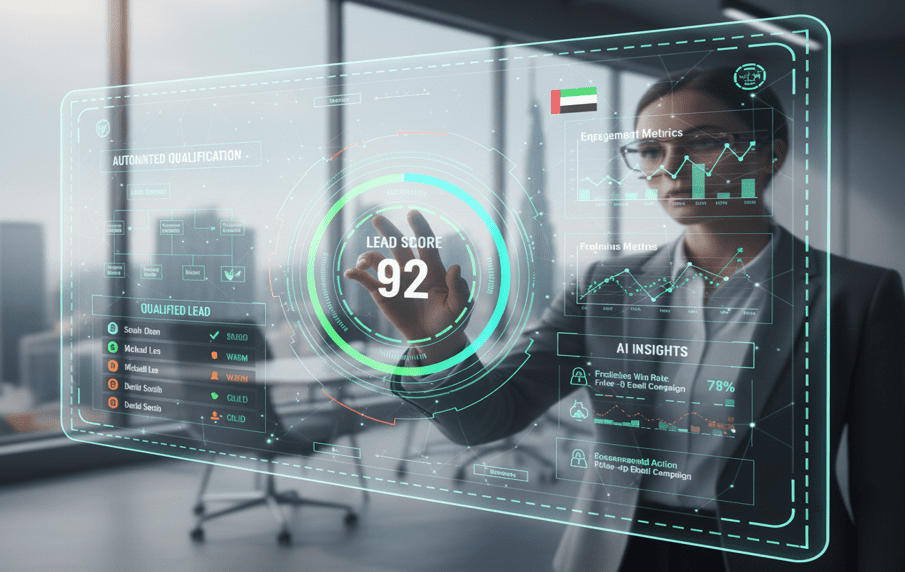
The seat at the table is shrinking.
Recent research reveals a troubling trend: only 40% of CXOs believe CMOs should have a seat on the board, and just 34% see their current marketing leader as a potential CEO successor. Meanwhile, the number of CMOs at Fortune 500 companies has declined from 71% to 66% in just one year.
For marketing leaders in the UAE – a region where bold vision meets relentless execution – this isn’t just a statistic. It’s a wake-up call.
While you’re pioneering campaigns for Dubai’s Vision 2030, shaping narratives for landmark developments, and driving growth in one of the world’s most competitive markets, the boardroom conversation is shifting beneath your feet. CEOs want growth. CFOs demand ROI. And both are questioning whether marketing can deliver at the speed and scale the business requires.
The good news? This isn’t about marketing losing relevance. It’s about marketing leadership evolving – and AI-powered digital agencies are the catalyst enabling CMOs to make that transformation.
The Credibility Crisis No One’s Talking About
Here’s the uncomfortable truth many CMOs face: 83% of CMOs remain confident in their brand’s equity, yet 70% of their CEOs say they’re not comfortable with modern marketing.
This disconnect isn’t about competence – it’s about communication, measurement, and the growing complexity of proving marketing’s business impact in a world where attribution is broken, data is fragmented, and privacy regulations have rewritten the rulebook.
Consider what you’re up against:
The ROI Reckoning: In 2026, CMOs are forced to prove marketing’s true contribution – not just clicks and conversions, but revenue impact. Attribution is broken, and marketing campaigns suffer because marketing spend is cut when CMOs cannot prove their return on investment.
The Budget Paradox: Marketing budgets remain stagnant at 7.7% of overall company revenue, with 59% of CMOs reporting insufficient budgets to execute their 2025 strategy. Yet both CEOs and CMOs agree – at 80% and 77% respectively – that marketing departments are underfunded.
The Expectation Explosion: You’re expected to be data scientist, technologist, brand guardian, growth driver, customer champion, and strategic visionary – all while navigating a market where 70% of executives say customer expectations are evolving faster than companies can adapt.
The Burnout Reality: 48% of marketing leaders report high or very high levels of burnout, grappling with external uncertainty and the pressure to demonstrate ROI while managing increasingly complex marketing ecosystems.
For CMOs in the UAE, these challenges are amplified. You’re operating in a market that demands world-class execution, serves a culturally diverse audience across multiple languages, and competes on a global stage where marginal advantages determine market leadership.
The question isn’t whether you can meet these challenges with traditional approaches. You can’t. The question is: what kind of partner do you need to transcend them?
From Marketing Leader to Growth Architect: The New CMO Mandate
The CMO role is not shrinking; it is expanding and evolving. Marketing has become central to national growth, not just business growth in the UAE context.
But this evolution demands more than broader responsibilities – it requires fundamentally different capabilities:
Financial Fluency That Commands Respect
When pitching a new marketing initiative, the difference between VP-level thinking and C-suite thinking is stark. A VP may highlight adoption rates and user engagement. A CMO frames it as: “This investment is expected to reduce churn by 4%, generate $2.5M additional revenue next year, and free up $500K in operational costs through automation”.
This isn’t about abandoning marketing metrics – it’s about translating them into boardroom language: EBITDA implications, customer lifetime value, market share gains, and contribution to enterprise goals.
AI-powered agencies bridge this gap by providing the attribution infrastructure and predictive analytics that enable you to speak with confidence about future business impact, not just past campaign performance.
Strategic Custody of the Customer
CMOs are increasingly expected to bring forward-looking customer insights into the boardroom and embed them into product development, innovation, and portfolio decisions. This means moving beyond campaign execution to become the voice of the customer at the management table.
In the UAE’s diverse market, this responsibility is particularly complex. You’re synthesizing insights across multiple demographic segments, cultural preferences, behavioral patterns, and digital touchpoints – all while navigating rapid market evolution and competitive intensity.
Traditional agencies provide campaign insights. AI-powered agencies provide strategic intelligence: predictive models of customer behavior, real-time competitive analysis, and actionable foresight that positions you as the growth strategist your CEO is looking for.
Data Mastery That Drives Decisions
63% of CMOs say they’re missing opportunities because they can’t make decisions fast enough. CMOs named unclear ownership and limited access to data and tools as the top barrier to delivering their strategy.
Speed isn’t just operational efficiency – it’s strategic advantage. In markets that reward first-movers and punish hesitation, the ability to make confident, data-driven decisions quickly separates market leaders from also-rans.
AI-powered agencies don’t just collect data – they transform it into decision velocity. Real-time dashboards, predictive analytics, and automated insights mean you’re making strategic moves while competitors are still analyzing last month’s reports.
The Five Capabilities That Separate AI-Powered Agencies From Traditional Partners
Not every agency claiming “AI capabilities” can deliver the strategic transformation CMOs need. Here’s what genuinely AI-powered partnerships provide:
1. Predictive ROI Modeling, Not Retrospective Reporting
Traditional agencies tell you which campaigns performed well last quarter. AI-powered agencies predict which strategies will drive the highest customer lifetime value three quarters from now – and adjust resource allocation accordingly.
This isn’t incremental improvement; it’s strategic foresight. When your CEO asks about next year’s growth trajectory, you’re providing data-driven projections, scenario modeling, and resource optimization strategies that demonstrate marketing’s role as the engine of predictable growth.
2. Multi-Touch Attribution That Actually Works
Traditional attribution models that heavily relied on third-party cookies no longer paint a useful picture of marketing performance. And, with first-party data, information is siloed across websites, CRMs and other channels, making it challenging to track attribution and prove ROI.
AI-powered agencies solve the attribution crisis through sophisticated modeling that tracks customer journeys across every touchpoint – digital, physical, and social – while respecting privacy regulations and building on first-party data strategies.
The result? You can finally answer the CFO’s toughest question with precision: “Which marketing activities are actually driving revenue, and how much should we invest in each?”
3. Real-Time Optimization at Enterprise Scale
When looking at optimising ad campaigns, the focus comes to the need for the human element even with digital platforms, emphasizing the importance of upskilling employees to understand data and measurement.
The most effective AI implementations don’t replace human strategy – they amplify it. While your team focuses on creative innovation, strategic positioning, and brand building, AI systems handle thousands of micro-optimizations daily: bid adjustments, budget reallocation, creative variations, audience refinement, and cross-channel orchestration.
This combination delivers results neither humans nor AI could achieve independently – and it positions you as the leader who’s leveraging technology to drive growth at scale.
4. Privacy-First Data Strategies That Build Trust
With privacy regulations reshaping the marketing landscape and consumer expectations for data protection rising, CMOs face a paradox: deliver hyper-personalization while respecting privacy boundaries.
AI-powered agencies resolve this through zero-party data collection strategies, consent-based personalization, and predictive models that deliver results without compromising customer trust. This isn’t just compliance – it’s competitive advantage in a market where trust drives loyalty.
5. Integrated Growth Intelligence Across Functions
Companies often don’t know who owns the customer, who’s advocating for the customer or who’s removing friction across the organization. The CMO is best suited to be the custodian of the customer across the enterprise.
AI-powered agencies provide the connective tissue that integrates insights across product, sales, service, and marketing – positioning you as the growth orchestrator who aligns disparate functions around a unified customer strategy.
The UAE Advantage: Why This Market Demands AI-Powered Marketing
The UAE presents unique opportunities and challenges that make AI-powered marketing not just beneficial, but essential:
Market Velocity: In Dubai and Abu Dhabi, business moves at extraordinary speed. AI agents are no longer science fiction, they’re starting to shop, decide, and act on behalf of people, transforming buying behaviour. Your strategies need to adapt as quickly as the market evolves.
Cultural Complexity: With over 200 nationalities and multiple languages, the UAE market demands personalization at a scale and sophistication that human teams alone cannot deliver. AI excels at processing cultural nuances, language preferences, and behavioral patterns across diverse segments simultaneously.
Digital Sophistication: UAE consumers are among the world’s most digitally savvy, with over 9.2 million mobile internet users spending an average of 7.5 hours online daily. They expect seamless, personalized experiences that anticipate their needs – expectations that AI-powered marketing is uniquely positioned to meet.
National Vision Alignment: Sustainability isn’t a side note, it’s the new business imperative, with a call to action: can marketing keep pace with the UAE’s bold sustainability vision, or risk falling behind? CMOs who align their strategies with Dubai Vision 2030 and national transformation initiatives position themselves as strategic partners in nation-building, not just brand-building.
Competitive Density: In saturated markets like luxury retail, hospitality, real estate, and financial services, the marginal gains from AI optimization often mean the difference between market leadership and irrelevance.
Reclaiming Your Seat: The Strategic Framework
Transforming from embattled CMO to indispensable growth architect requires a deliberate approach. Here’s the framework that’s working for marketing leaders who’ve successfully elevated their boardroom influence:
Phase 1: Establish Your North Star Metrics
55% of CEOs measure marketing’s impact based on year-on-year revenue growth and margin, yet only 33% of CMOs track these as top metrics. Close this gap immediately.
Work with your CEO and CFO to identify the 3-5 metrics that matter most to the board – likely revenue growth, customer acquisition cost, lifetime value, market share, and margin contribution. Then build your measurement framework around proving marketing’s impact on these specific outcomes.
An AI-powered agency provides the attribution infrastructure to track these metrics accurately and the predictive models to forecast future impact with confidence.
Phase 2: Build Your Data Foundation
CMOs must adopt advanced attribution models that map out customer interactions across various channels and touchpoints, enabling them to measure specific marketing initiatives’ direct and ancillary effects on revenue generation.
This isn’t a quick fix – it’s an infrastructure investment. But it’s the foundation that enables everything else: accurate attribution, predictive modeling, real-time optimization, and data-driven strategy.
Partner with an AI-powered agency that can implement this infrastructure without disrupting existing operations, integrating with your current martech stack while building toward a unified data strategy.
Phase 3: Demonstrate Quick Wins
Launch AI-powered pilot programs in areas where you can demonstrate clear, measurable ROI quickly – perhaps paid media optimization, email personalization, or customer segmentation refinement.
Document baseline performance, implement AI-driven improvements, and report results in the language the board understands: cost savings, revenue increases, efficiency gains, and customer value improvements.
These quick wins build credibility for larger strategic initiatives while proving that AI delivers results, not just promises.
Phase 4: Scale Strategic Transformation
With credibility established and infrastructure in place, scale AI-powered approaches across all marketing functions: brand strategy informed by predictive analytics, product development guided by customer intelligence, pricing optimization based on market dynamics, and omnichannel orchestration that delivers seamless experiences.
At this stage, you’re no longer defending marketing’s value – you’re demonstrating marketing’s indispensability as the growth engine the CEO is looking for.
Phase 5: Own the Growth Narrative
Marketing can be the unifying force that drives growth. When this happens, data shows that growth follows.
With AI-powered insights, predictive models, and proven ROI, you’re positioned to do what few marketing leaders can: walk into the boardroom with a comprehensive growth strategy that unifies product, sales, service, and marketing around a data-driven vision for the future.
You’re no longer reporting on marketing activities – you’re presenting the growth roadmap the entire organization will follow.
The Cost of Waiting: Why It is Your Inflection Point
Every quarter you delay implementing AI-powered marketing strategies is a quarter you fall further behind competitors who are already leveraging these capabilities.
Consider the compounding effects:
- Erosion of Credibility: As CFOs and CEOs become more sophisticated about marketing analytics, vague claims about brand value and fuzzy attribution models erode your influence
- Competitive Disadvantage: Competitors with AI-powered insights are making faster, smarter decisions about market opportunities, customer acquisition, and resource allocation
- Talent Drain: Top marketing talent increasingly expects to work with cutting-edge tools and data-driven approaches – outdated infrastructure makes it harder to attract and retain the team you need
- Budget Vulnerability: Without clear ROI demonstration, marketing budgets are the first to face cuts during economic uncertainty
- Strategic Marginalization: As the boardroom gets more crowded with specialized roles, CMOs without differentiated strategic value risk becoming execution managers rather than growth architects
The transformation happening in marketing leadership isn’t subtle – it’s dramatic. CMOs who embrace AI-powered partnerships are gaining influence, growing budgets, and earning recognition as strategic growth drivers. Those who resist are finding their roles diminished, their budgets cut, and their influence marginalized.
What to Look for in Your AI-Powered Partner
Not all agencies claiming AI expertise can deliver the strategic transformation CMOs need. Here’s how to identify genuine partners:
1. Proprietary Intelligence, Not Repackaged Platforms: Do they have their own AI models trained on marketing data, or are they just reselling generic tools anyone can access?
2. Financial Acumen: Can they speak CFO language? Do they understand EBITDA implications, customer lifetime value modeling, and contribution margin analysis?
3. Strategic Partnership Model: Are they positioned as vendors executing your plans, or strategic partners helping shape your growth strategy?
4. UAE Market Expertise: Do they understand the unique dynamics of this region—cultural diversity, regulatory environment, competitive landscape, and national vision alignment?
5. Integration Capabilities: Can they seamlessly connect with your existing martech stack, CRM systems, and data infrastructure without requiring a complete rebuild?
6. Transparent Methodology: Can they explain how their AI systems make decisions, or is it a black box that makes you dependent on their expertise without building your internal capabilities?
7. Proven C-Suite Impact: Can they demonstrate specific examples of helping CMOs elevate their boardroom influence, not just improve campaign metrics?
The Future Belongs to Growth Architects
The marketing leaders thriving share common traits:
- They speak the language of finance while preserving the art of storytelling
- They leverage AI while championing human creativity
- They prove ROI while building long-term brand equity
- They optimize current performance while investing in future capabilities
- They serve as strategic partners to the CEO while advocating for the customer
They’ve stopped defending marketing’s value and started demonstrating marketing’s indispensability.
They’ve transformed from campaign managers into growth architects – the leaders their organizations turn to not just for marketing execution, but for strategic direction on how to capture market opportunities, build customer loyalty, and drive sustainable growth.
Your Move
The boardroom battle for CMO influence isn’t won with better presentations or more eloquent arguments about brand value. It’s won with data-driven strategies, predictive intelligence, and proven ROI that positions marketing as the growth engine your CEO is looking for.
For marketing leaders in the UAE – a region where vision meets execution at extraordinary speed – this transformation isn’t optional. It’s the defining challenge of your tenure.
The CMOs who will dominate the next five years won’t be those with the biggest budgets or the longest tenures. They’ll be those with the smartest systems, the richest data strategies, and the most sophisticated AI-powered partners.
The question isn’t whether AI-powered marketing will reshape leadership dynamics in the boardroom. That’s already happening.
The question is: will you lead this transformation, or will you be trying to catch up while competitors claim the growth architect role you should be owning?
Elevate Your Leadership. Transform Your Results.
DigiNeura combines cutting-edge AI capabilities with deep strategic expertise to help UAE marketing leaders reclaim their seat at the table and own the growth narrative.
We don’t just optimize campaigns – we transform CMOs into growth architects with:
✓ Predictive ROI modeling that enables confident strategic planning
✓ Multi-touch attribution infrastructure that proves marketing’s business impact
✓ Real-time optimization at enterprise scale across all channels
✓ Privacy-first data strategies that build customer trust while driving personalization
✓ Integrated growth intelligence that positions you as the customer champion your organization needs
Our AI-powered approach goes beyond tactical improvements to deliver the strategic transformation that earns boardroom credibility and CEO confidence.
Ready to transform your leadership impact?
Schedule a confidential strategic assessment to discover how DigiNeura can help you prove ROI, demonstrate strategic value, and position marketing as the growth engine driving your organization’s success in the UAE market.
Contact DigiNeura today – because the future belongs to growth architects, not campaign managers.